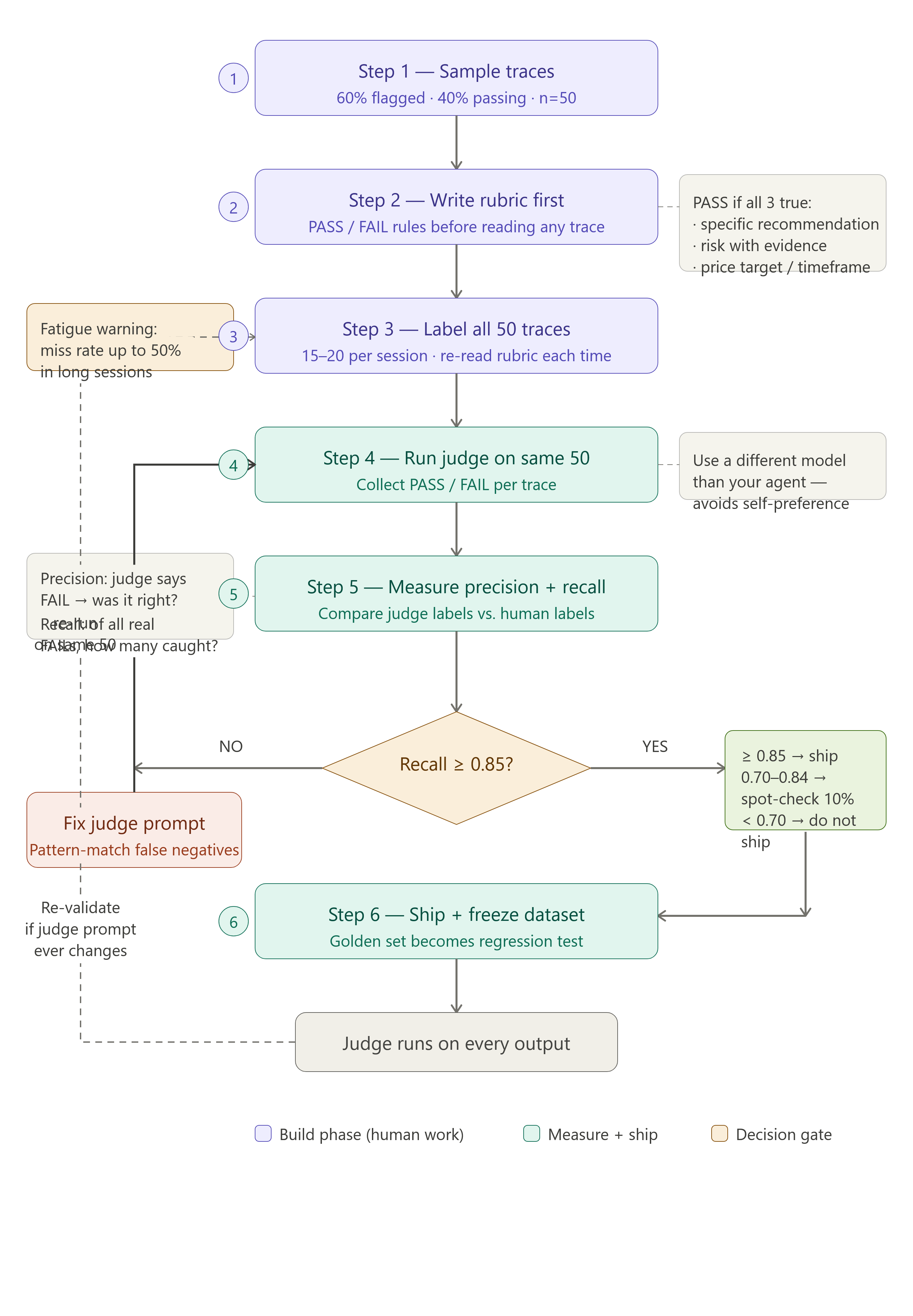
How this guide is grounded. The framework below is written to apply to any agentic or RAG system. Where it draws on a real production build — EquipmentIQ, a multi-agent RAG platform for CNC predictive maintenance — that material is marked in a “Case Study” note with a citation, so you can tell general practice apart from one project’s specific numbers.
📬 Open to freelance and consulting work in agentic AI evaluation, RAG architecture, and AI trust/compliance tooling — see Work with me at the end.
Contents
- Why evaluation is different for agentic AI
- The evaluation stack — three layers
- Building ground truth before you build the system
- Development evaluation
- Pre-deployment gates
- Continuous production evaluation
- The feedback loop — turning users into evaluators
- Common failure modes and how to diagnose them
- The evaluation mindset — key principles
- Quick reference — metrics cheat sheet
- Appendix — a case study end to end
- References & citations
- Work with me
1. Why evaluation is different for agentic AI
Traditional software has deterministic outputs — a function returns the same result for the same input. Agentic AI systems do not. A multi-agent RAG system typically has at least five independent sources of non-determinism:
- Intent classification — the same query can route to different agents depending on model temperature and prompt phrasing
- Retrieval — vector similarity rankings shift as embeddings change or collections are updated
- Reranking — cross-encoder scores vary with model version and chunk context
- Synthesis — LLM generation is stochastic by nature
- Feedback loops — the system changes over time as golden sets grow and prompts are tuned
You cannot test a system like this the way you test regular software. You need a layered evaluation framework that treats each component as a measurable subsystem, not a black box.
Evaluation is not something you add after the system works. It is the definition of what “works” means.
📎 Case study — EquipmentIQ A system can look finished and still be silently broken. After the agent and orchestrator layer of EquipmentIQ was built, the system produced plausible answers end to end. Only once a dedicated evaluation pipeline was run did five separate defects surface at once: retrieval scoring at zero across every collection, a faithfulness metric reading near zero because context wasn’t reaching the scorer, a ranking formula that mathematically couldn’t produce the values it was producing, one domain’s queries silently routing to the wrong agent, and an embedding dimension mismatch between ingestion and retrieval. None of these were visible from reading the system’s output — the answers looked fine. They were only visible once evaluation existed as its own subsystem. — Madkour, M., EquipmentIQ project notes, 2026. See References.
2. The evaluation stack — three layers
Every agentic AI system needs evaluation at three distinct layers. Don’t conflate them: they measure different things and require different fixes.
flowchart BT
    L1["<b>Layer 1 — Retrieval Quality</b><br/>NDCG@K · Hit Rate@K · MRR · Routing Accuracy"]
    L2["<b>Layer 2 — Generation Quality</b><br/>Faithfulness · Answer Relevance · LLM-as-Judge"]
    L3["<b>Layer 3 — System / Production Health</b><br/>Latency · Token Cost · Drift · Feedback Sentiment"]
    L1 --> L2 --> L3
    style L1 fill:#E4F2F1,stroke:#0E7C7B,stroke-width:2px
    style L2 fill:#EFF6F5,stroke:#0E7C7B
    style L3 fill:#F7FBFA,stroke:#0E7C7B
Fig. 1 — Retrieval is the foundation. Fix it first: a generation-quality problem is often a retrieval problem wearing a different symptom.
Layer 1 — Retrieval quality
Retrieval is the foundation. A system with poor retrieval cannot produce good answers regardless of how good the synthesis model is. Fix retrieval first, always.
Layer 2 — Generation quality
Once retrieval is correct, measure whether the model is using the retrieved context faithfully. The critical distinction:
- High faithfulness, good judge score → the system is working correctly
- Low faithfulness, good judge score → context isn’t reaching the scorer — a code bug, not a quality problem
- High faithfulness, poor judge score → retrieval is correct but the synthesis prompt needs work
- Low faithfulness, poor judge score → both retrieval and synthesis have issues
Layer 3 — System health
Production systems degrade over time even without code changes. Embedding drift occurs when query patterns shift away from the indexed document distribution. Latency increases as collections grow. Token costs rise as context windows expand. Layer 3 catches these invisible degradations before users notice them.
📎 Case study — EquipmentIQ When one domain’s retrieval scored zero, the first suspect was the synthesis model. The actual cause was upstream: that domain’s queries were being routed to a general cross-domain handler instead of its dedicated agent, which pulled chunks from every collection and buried the relevant ones. Layer-1 evaluation surfaced a routing bug that Layer-2 evaluation alone would have hidden — the answers it produced still read fine. — Madkour, M., EquipmentIQ project notes, 2026.
3. Building ground truth before you build the system
The most common evaluation mistake is building the golden set after the system is working. That creates circular validation — you tune the system until it passes tests you wrote while looking at the system’s own output.
Build the golden set first
A golden set is a collection of ground-truth question–answer pairs where you know the correct answer independently of what your system produces. A useful starting size is 10 entries per agent or domain, built before a single evaluation run.
{
  "query": "What is the maximum retry window for a failed webhook delivery?",
  "domain": "api_docs",
  "expected_doc_ids": ["webhooks_retries#3", "webhooks_retries#4"],
  "ground_truth_answer": "Failed webhook deliveries are retried for up to
    24 hours using exponential backoff. After the final attempt, the event
    is marked as failed and must be replayed manually via the events API."
}
The golden set rules
Rule 1 — Use real data for expected_doc_ids. Never write expected IDs from memory or documentation. Query your live collection and use the IDs it actually returns. A golden set written by hand often assumes a clean ID like webhooks_retries, while the collection actually stores chunk-level IDs like webhooks_retries#3 or webhooks_retries_v2_chunk_04. That mismatch alone can make every retrieval score come back as zero — not because retrieval failed, but because the comparison never had a chance to match.
Rule 2 — Grow the golden set organically from failures. Every negatively-rated user query where you know the correct answer becomes a new golden set entry. This keeps your evaluation aligned with real usage patterns rather than synthetic test cases.
Rule 3 — Version control the golden set. golden_set.jsonl lives in your repository. Every addition goes through a pull request with the new pair and the evaluation score it produces — this prevents silent degradation when someone edits the golden set to make a failing test pass.
Rule 4 — Ten entries per agent is a floor, not a target. Fewer than 10 entries per domain makes ranking metrics too noisy to trust. At 10 entries, a single routing failure drops NDCG by 0.10 — detectable, and proportionate. At 3 entries, one failure drops it by 0.33 — which looks catastrophic and can trigger unnecessary intervention.
📎 Case study — EquipmentIQ EquipmentIQ’s golden set held 30 Q&A pairs — 10 per agent across a three-agent system — built before any evaluation run. Rule 1 was learned the hard way: early entries used clean IDs like
DOC-EIQ-001, while the vector store stored chunk-level IDs such asDOC-EIQ-001_Machine_Overview_chunk_3. Every retrieval score came back at zero until the golden set was rebuilt from a live query against the collection. — Madkour, M., EquipmentIQ project notes, 2026.
4. Development evaluation
During development, evaluation serves a different purpose than it does in production: the goal is to make retrieval and routing deterministic before worrying about generation quality at all.
flowchart LR
    A["Write code<br/>or change a prompt"] --> B["Run unit tests<br/>deterministic, mocked"]
    B --> C["Run retrieval eval<br/>live collection"]
    C -->|failing| D["Diagnose & fix<br/>root cause, not symptom"]
    D --> A
    C -->|passing| E["Move to generation eval"]
    style D fill:#FBEAE9,stroke:#B23A34
    style E fill:#E7F3ED,stroke:#2F7D5C
Fig. 2 — Never skip to generation evaluation while retrieval is still failing: from the outside, retrieval bugs and generation bugs look identical.
Unit tests vs. evaluation tests
| Unit tests | Evaluation tests |
|---|---|
| Test code correctness | Test system quality |
| Deterministic pass/fail | Probabilistic thresholds |
| Run in milliseconds | Take seconds to minutes |
| Run on every commit | Run on a schedule or trigger |
| Mock external dependencies | Use real collections and APIs |
The NDCG formula — get it right
NDCG (Normalized Discounted Cumulative Gain) is the standard retrieval quality metric. A common implementation bug uses 1/(i+1) instead of 1/log₂(rank+1), which can produce values above 1.0 — a mathematically impossible result that signals a formula error, not a great system. The corrected, standalone implementation:
# retrieval_metrics.py
import math

def ndcg_at_k(retrieved_ids, expected_ids, k=5):
    """
    Normalized Discounted Cumulative Gain at rank k.
    retrieved_ids: ordered list of document/chunk IDs returned by the retriever
    expected_ids:  set (or list) of IDs known to be relevant, from the golden set
    """
    dcg = 0.0
    for rank, doc_id in enumerate(retrieved_ids[:k], start=1):
        relevance = 1.0 if doc_id in expected_ids else 0.0
        dcg += relevance / math.log2(rank + 1)

    # Ideal DCG: all relevant docs occupy the top positions
    n_relevant = min(len(expected_ids), k)
    idcg = sum(1.0 / math.log2(rank + 1) for rank in range(1, n_relevant + 1))

    if idcg == 0:
        return 0.0

    return min(1.0, dcg / idcg)  # clamp — any value above 1.0 is a formula bug
Always add the hard clamp to [0.0, 1.0] as a safety net.
Routing accuracy — the overlooked metric
In a multi-agent system, routing accuracy matters as much as retrieval quality. A query routed to the wrong agent produces a confidently wrong answer — often more harmful than no answer at all. A reasonable target is 95% accuracy across a labelled set of roughly 10 queries per domain.
When routing degrades, resist the temptation to fix it by lowering the confidence threshold — that just redistributes ambiguous queries to arbitrary agents instead of resolving the ambiguity. Fix it by adding explicit examples and disambiguating rules to the classification prompt.
Embedding consistency — the silent killer
Ingestion, retrieval, and evaluation must all use identical embedding configuration: same model, same dimensions, same distance metric. A common and completely silent failure mode is ingesting with one embedding model (say, a 1536-dimension model) and retrieving with a vector store’s different default (say, a 384-dimension model) — every query then fails a dimension check and returns empty results, with no visible error in the generated answer.
# embeddings.py — one client, everywhere
# Define the embedding function once and reuse it for ingestion,
# retrieval, and evaluation — never let two code paths choose their own default.

from chromadb.utils import embedding_functions

embedder = embedding_functions.OpenAIEmbeddingFunction(
    api_key="...",
    model_name="text-embedding-3-small",
)

collection = client.get_or_create_collection(
    name="docs",
    embedding_function=embedder,          # same embedder used at query time
    metadata={"hnsw:space": "cosine"},    # explicit distance metric
)
📎 Case study — EquipmentIQ EquipmentIQ maintained 91 unit tests running in under 60 seconds with all external dependencies mocked, alongside a separate evaluation suite that ran against live ChromaDB collections and real API calls. Its own NDCG bug matched the formula error above exactly — the corrected version shown here is the fix that shipped. Its routing bug came from a support domain being confused with a general-purpose fallback, resolved by adding explicit disambiguating examples rather than touching the confidence threshold. — Madkour, M., EquipmentIQ project notes, 2026.
5. Pre-deployment gates
Before any change goes to production — a new prompt, a new chunk size, a new model, new documents — the system should pass a set of numerical gates. A typical gate set:
| Gate | Metric | Target | On failure |
|---|---|---|---|
| AC-001 | NDCG@5 per domain | ≥ 0.70 | 🔴 Blocks deploy |
| AC-002 | Hit Rate@5 per domain | ≥ 0.85 | 🔴 Blocks deploy |
| AC-003 | Faithfulness (RAGAS) | ≥ 0.80 | 🔴 Blocks deploy |
| AC-004 | Routing accuracy | ≥ 95% | 🔴 Blocks deploy |
| AC-005 | P95 latency, single agent | ≤ 10s | 🔴 Blocks deploy |
| AC-006 | P95 latency, cross-domain | ≤ 20s | 🟡 Advisory |
flowchart LR
    A[Change proposed] --> B["Run evaluation gates<br/>AC-001 … AC-006<br/>golden set + live latency"]
    B -->|all pass| C[✅ Deploy]
    B -->|any fail| D[🚫 Blocked — fix & re-run]
    style C fill:#E7F3ED,stroke:#2F7D5C
    style D fill:#FBEAE9,stroke:#B23A34
Fig. 3 — Gates run as part of CI, not as a manual checklist someone remembers to run.
The batch evaluation runner exits with a non-zero status when any gate fails, which is what allows it to block a CI/CD pipeline:
# batch_eval.py — CI gate
import sys

NDCG_GATE = 0.70
FAITHFULNESS_GATE = 0.80
ROUTING_GATE = 0.95

def run_gates(results: dict) -> int:
    """
    results: {"ndcg": {domain: score, ...}, "faithfulness": score, "routing": score}
    Returns process exit code — 0 if every gate passes, 1 otherwise.
    """
    failures = []

    for domain, ndcg in results["ndcg"].items():
        if ndcg < NDCG_GATE:
            failures.append(f"NDCG gate FAIL ({domain}): {ndcg:.3f} < {NDCG_GATE}")

    if results["faithfulness"] < FAITHFULNESS_GATE:
        failures.append(f"Faithfulness gate FAIL: {results['faithfulness']:.3f} < {FAITHFULNESS_GATE}")

    if results["routing"] < ROUTING_GATE:
        failures.append(f"Routing gate FAIL: {results['routing']:.3f} < {ROUTING_GATE}")

    if failures:
        for f in failures:
            print(f"  - {f}")
        return 1  # blocks deployment

    print("All gates passed.")
    return 0

if __name__ == "__main__":
    sys.exit(run_gates(load_latest_results()))
Calibrating the gates
Start with conservative targets (NDCG ≥ 0.60, faithfulness ≥ 0.70) and raise them as the system matures. Targets set too high initially block legitimate deployments; set too low, the gates never catch a real problem. A workable pattern is to calibrate the first gate against your golden set’s baseline score, then tighten it once the system is stable — for example, once a domain reliably scores 1.00 on NDCG, its gate can move from 0.70 to 0.85 to catch regressions more sensitively.
6. Continuous production evaluation
Production evaluation serves a different purpose than development evaluation. The goal isn’t to verify the system works — it’s to detect when it stops working, before users notice.
Not all evaluation is equal in cost. Run cheap checks constantly and expensive ones on a schedule:
| Tier | Frequency | What runs | Cost per run |
|---|---|---|---|
| Real-time | Every query | Latency, routing domain, chunk count | $0.00 |
| Sampled online | 10–15% of traffic | Faithfulness, LLM-as-Judge | ~$0.004 |
| Triggered | On every feedback submission | Signal extraction, metric correlation | ~$0.001 |
| Nightly batch | Daily | NDCG, MRR, drift detection | ~$0.02 |
| Weekly regression | Weekly | Full golden set evaluation | ~$0.10 |
| On deployment | Every code/prompt change | Full golden set, latency | ~$0.10 |
Embedding drift detection
Embedding drift occurs when the distribution of production queries shifts away from the distribution of your indexed documents — a natural effect of usage patterns evolving past what the system was originally built for.
# drift_monitor.py
import numpy as np

def compute_centroid(collection):
    """Mean embedding vector across every item in a vector store collection."""
    all_embeddings = collection.get(include=["embeddings"])["embeddings"]
    return np.mean(all_embeddings, axis=0)

def detect_drift(collection, baseline_path, threshold=0.15):
    """
    Compares the current collection centroid to a saved baseline.
    Save a new baseline (np.save) after every intentional collection update.
    """
    current = compute_centroid(collection)
    baseline = np.load(baseline_path)

    similarity = np.dot(current, baseline) / (
        np.linalg.norm(current) * np.linalg.norm(baseline)
    )
    drift = 1 - similarity
    return {"drift": float(drift), "alert": drift > threshold}
Observability — what to read in a trace
Every production query should produce a trace with named spans for each step in the pipeline:
run_query                          1.2s total
├── classify_intent                  85ms   domain=billing confidence=0.94
├── retrieve                        340ms   chunks=5 top_score=0.87
├── merge_context                     2ms   deduped=5
├── synthesize                      780ms   tokens_in=1240 tokens_out=312
└── log_trace                         1ms   citations=3
What to watch for: intent-classification confidence consistently below 0.75 (the prompt needs more examples for those patterns), an agent returning zero chunks (embedding drift or a collection issue), synthesis latency climbing past a few seconds (context window too large — reduce top-k), or every query landing in a generic fallback domain (confidence threshold needs recalibration).
7. The feedback loop — turning users into evaluators
Human feedback is the most valuable signal in any AI system, because it captures something automated metrics cannot: whether the answer was actually useful for the user’s specific situation.
flowchart LR
    A["1 · Capture<br/>thumbs + free text"] --> B["2 · Signal extraction<br/>classify failure mode"]
    B --> C["3 · Metric correlation<br/>human vs. automated"]
    C --> D["4 · Golden set growth<br/>harder over time"]
    D -.->|feeds back into| A
    style D fill:#E7F3ED,stroke:#2F7D5C
Fig. 4 — Every negatively-rated query with a known correct answer becomes tomorrow’s golden set entry.
Stage 1 — Capture. Every response gets an optional feedback widget. Store, at minimum, the query, the agent routed, the generated answer, the retrieved chunk IDs, and any automated scores already computed for that query.
# feedback.py — capture schema
from dataclasses import dataclass, field
from datetime import datetime, timezone

@dataclass
class FeedbackRecord:
    query: str
    domain: str
    answer: str
    retrieved_ids: list[str]
    rating: str                    # "up" | "down"
    comment: str | None = None
    automated_scores: dict = field(default_factory=dict)
    timestamp: str = field(default_factory=lambda: datetime.now(timezone.utc).isoformat())
Stage 2 — Signal extraction. Raw free-text feedback is noisy. Run it through a small classification step to extract structured signal:
-
wrong_answer— factually incorrect -
incomplete— partially correct, missing key information -
hallucinated— contains information not in the retrieved context -
out_of_scope— the system answered a question it should have declined -
correct— accurate and complete
Stage 3 — Metric correlation. Compare human ratings against automated scores for the same queries. A negative human rating paired with a high automated faithfulness score is a discordant case worth investigating: if users dislike answers that score well on faithfulness, the metric may be measuring “grounded” when the real problem is “incomplete.” If users like answers that score poorly, the scorer likely has a bug. A discordant rate above 20% is a signal to audit your automated metrics, not your product.
Stage 4 — Golden set growth. Every negatively-rated query with a known correct answer becomes a new golden set entry — the compounding, long-term benefit of collecting user feedback at all.
Human feedback is the calibration layer for automated metrics, not a replacement for them.
8. Common failure modes and how to diagnose them
Use this as a debugging playbook. Each pattern below recurs across different RAG and multi-agent stacks — only the surface symptom changes.
flowchart TD
    Start["Answer is wrong"] --> R{"Routing:<br/>correct agent?"}
    R -->|no| R1["Fix intent<br/>classification prompt"]
    R -->|yes| Ret{"Retrieval:<br/>right chunks?"}
    Ret -->|no| Ret1["Check embeddings,<br/>golden-set IDs"]
    Ret -->|yes| Syn{"Synthesis:<br/>used the context?"}
    Syn -->|no| Syn1["Tighten prompt,<br/>lower temperature"]
    Syn -->|yes| Ev{"Evaluation:<br/>is the metric right?"}
    Ev -->|NDCG > 1| Ev1["Fix formula"]
    Ev -->|scores perfect,<br/>answer still wrong| Ev2["Fix golden set"]
    style Start fill:#171A1C,stroke:#171A1C,color:#fff
    style R1 fill:#FBEAE9,stroke:#B23A34
    style Ret1 fill:#FBEAE9,stroke:#B23A34
    style Syn1 fill:#FBEAE9,stroke:#B23A34
    style Ev1 fill:#FBEAE9,stroke:#B23A34
    style Ev2 fill:#FBEAE9,stroke:#B23A34
Fig. 5 — Work top to bottom. A generation fix applied while retrieval is still broken will not hold.
Failure — a ranking metric scores zero across the board
Symptom: Every query scores zero regardless of how good retrieval looks on manual inspection. Diagnosis: The golden set’s expected document IDs don’t match the actual IDs in the collection — almost always a format mismatch, e.g. a clean ID in the golden set versus a chunk-suffixed ID in the store. Fix: Query each collection for each golden entry and replace the expected IDs with whatever the collection actually returns. Prevention: Never write expected IDs from memory — always extract them from a live query.
Failure — NDCG above 1.0
Symptom: A mathematically impossible score, like 1.28. Diagnosis: The DCG formula is using 1/(i+1) instead of 1/log₂(rank+1). Fix: Use the corrected formula (Section 4) and add a hard clamp to [0.0, 1.0].
Failure — faithfulness near zero but a judge model rates the answers highly
Symptom: Faithfulness and judge scores contradict each other — the judge thinks the answers are good, faithfulness says they’re ungrounded. Diagnosis: The faithfulness scorer is receiving empty context or the wrong object type. It reports 0.0 because it sees no supporting evidence, not because the answers are actually unfaithful — a code bug, not a quality problem. Fix: Add a debug print before the scoring call to inspect the type and content of the context argument. Common causes: an empty list where merged context should be; retrieval result objects passed in place of plain strings; a scoring library failing silently against a non-default model provider.
Failure — an ambiguous domain routes to the wrong handler
Symptom: One domain’s retrieval metric is very low or zero, and inspection shows its queries being classified into a general fallback instead of their dedicated agent. Diagnosis: The intent classifier lacks enough examples for that domain. A query like “this isn’t working the way it should” is genuinely ambiguous — it could be a technical fault report or a support complaint, and the classifier has no strong signal either way. Fix: Add explicit examples to the classification prompt and a categorical rule for the domain’s distinguishing vocabulary (case numbers, remedy requests, specific ID formats). Don’t lower the confidence threshold as a substitute.
Failure — embedding dimension mismatch
Symptom: Retrieval returns empty results, or raises a dimension mismatch error silently. Diagnosis: Ingestion and retrieval are using different embedding clients — a common trap when one code path defaults to a vector store’s built-in embedder while another explicitly configures a different model. Fix: Use one embedding client throughout, passed explicitly to every collection call (see Section 4).
Failure — routing accuracy regresses after a prompt update
Symptom: Previously correct routing decisions start failing after a change to the intent classification prompt. Diagnosis: The prompt change removed examples that were implicitly disambiguating edge cases, and the routing test set wasn’t comprehensive enough to catch the regression. Fix: Maintain a labelled routing test set (roughly 10 queries per domain) that runs automatically after every prompt change, and treat routing accuracy as a hard gate rather than a metric you check occasionally.
9. The evaluation mindset — key principles
Evaluate the right layer first. Retrieval → routing → generation → system health. Always in this order. Generation problems are invisible when retrieval is broken. Routing problems cause retrieval problems. System health problems cause everything else eventually.
Your automated metrics are only as good as your ground truth. An NDCG of 1.00 means nothing if the expected document IDs are wrong. An LLM-judge score of 4.5/5 means nothing if the judge prompt is poorly calibrated. A faithfulness score of 0.90 means nothing if the scorer is receiving empty context. Validate your evaluation framework before you trust its output.
Human feedback calibrates automated metrics. Don’t replace human feedback with automated metrics — use them together. Automated metrics scale to all traffic; human feedback reveals when automated metrics are measuring the wrong thing. When they disagree, investigate — never assume the automated metric is the one that’s right.
Fix root causes, not symptoms. When a ranking metric is low, the temptation is to lower the threshold. When routing is wrong, the temptation is to adjust the confidence threshold. Both are symptom fixes. The root causes — golden set ID mismatches, thin prompt examples, embedding inconsistency — keep causing problems long after the threshold has been adjusted.
Evaluation infrastructure is production code. Treat your metrics module, batch evaluation runner, and golden set with the same engineering rigor as your agent code: unit tests, version control, code review. An evaluation bug is as damaging as a production bug, because it gives you false confidence.
Commit after every green evaluation run. The moment all gates pass, commit. Evaluation results are ephemeral — the next change might break something. A git history where every commit has a passing evaluation gives you clean rollback points and a record of exactly when a degradation was introduced.
10. Quick reference — metrics cheat sheet
Retrieval metrics
| Metric | Formula | Interpretation | Target |
|---|---|---|---|
| NDCG@K | DCG / IDCG, DCG = Σ rel / log₂(rank+1) | Ranking quality — rewards relevant docs at the top | ≥ 0.70 |
| Hit Rate@K | 1 if any expected doc in top K, else 0 | Binary — did we find anything relevant? | ≥ 0.85 |
| MRR | 1 / rank of first relevant result | How high is the first correct answer? | ≥ 0.60 |
Generation metrics
| Metric | What it measures | Tool | Target |
|---|---|---|---|
| Faithfulness | Are claims grounded in context? | RAGAS or LLM-as-Judge | ≥ 0.80 |
| Answer Relevance | Does the answer address the question? | RAGAS | ≥ 0.75 |
| LLM-as-Judge | Overall quality, 1–5 rubric | Separate model instance | ≥ 3.5 / 5 |
# llm_judge.py — standalone scorer
import json

JUDGE_PROMPT = """You are grading an AI assistant's answer for a support system.

Question: {question}
Retrieved context: {context}
Answer to grade: {answer}

Score the answer from 1-5 on:
- Groundedness: is every claim supported by the retrieved context?
- Completeness: does it fully address the question?
- Clarity: would the intended reader understand it without follow-up?

Respond with only a JSON object: score
"""

def llm_as_judge(question, context, answer, client, model="your-judge-model"):
    """
    `client` is any chat-completion client exposing a .complete(prompt) -> str
    method. Swap in your provider of choice; the grading logic is provider-agnostic.
    """
    prompt = JUDGE_PROMPT.format(question=question, context=context, answer=answer)
    response = client.complete(prompt, temperature=0.0)
    return json.loads(response)
System health metrics
| Metric | What it measures | Alert threshold |
|---|---|---|
| Embedding drift | Cosine distance, current vs. baseline centroid | > 0.15 |
| P95 latency, single agent | 95th percentile end-to-end response time | > 10s |
| P95 latency, cross-domain | 95th percentile for parallel retrieval | > 20s |
| Routing accuracy | % of queries routed to the correct agent | < 95% |
| Discordant rate | % negative feedback with high automated scores | > 20% |
Appendix — a case study end to end
Every principle above is written to generalize. This appendix is the one place in the guide where a single project’s actual numbers are shown in full, so you can see how the framework reads against a real system rather than an idealized one.
EquipmentIQ is a production-grade multi-agent RAG system for CNC machinery predictive maintenance, built across three domain agents on top of the Bosch CNC Machining Dataset — 1,702 real vibration recordings from three brownfield milling machines, covering 70 real fault events, released under CC BY 4.0 (Tnani, Feil & Diepold, 2022 — see References). The stack: LangGraph for orchestration, ChromaDB across three isolated collections, OpenAI embeddings, an Anthropic Claude model for both synthesis and as an evaluation judge, RAGAS for generation metrics, and LangSmith for tracing.
| Metric | Value | Gate | Status |
|---|---|---|---|
| Mechanical NDCG@5 | 1.00 | ≥ 0.70 | ✅ PASS |
| Software NDCG@5 | 1.00 | ≥ 0.70 | ✅ PASS |
| Support NDCG@5 | 1.00 | ≥ 0.70 | ✅ PASS |
| Mechanical Hit Rate@5 | 1.00 | ≥ 0.85 | ✅ PASS |
| Software Hit Rate@5 | 1.00 | ≥ 0.85 | ✅ PASS |
| Support Hit Rate@5 | 1.00 | ≥ 0.85 | ✅ PASS |
| MRR@5 | 0.966 | ≥ 0.60 | ✅ PASS |
| Routing accuracy | 91.9% (34/37) | ≥ 95% | 🟡 Close — support routing itself was 100% |
| Embedding drift | 0.00 (baseline) | < 0.15 | ✅ PASS |
| Unit tests | 85 / 97 | All pass | 🟡 12 integration tests pending live API |
Eight distinct bugs surfaced and were resolved across the project’s lifecycle — spanning the ID-mismatch, NDCG-formula, faithfulness-context, and routing-ambiguity patterns described in Section 8, plus a document re-indexing gap and a dashboard logging bug that showed all-zero results because a results-saving call was missing entirely. Two things worth naming honestly, since a portfolio piece that only reports clean wins isn’t a useful reference: a data gap assessment found real discrepancies between the dataset’s documentation and its actual behavior — some fault cycles scored contrary to what the documentation implied, and coverage of certain anomaly types in real recordings was thin — and the knowledge base used for retrieval is domain-authentic synthetic text layered on top of the dataset’s real sensor recordings, not a natively text-based source. Both are disclosed here rather than smoothed over, in keeping with Section 9’s principle that your evaluation is only as trustworthy as your honesty about its ground truth.
References & citations
- [Dataset] Tnani, M.-A., Feil, M., & Diepold, K. (2022). Smart Data Collection System for Brownfield CNC Milling Machines: A New Benchmark Dataset for Data-Driven Machine Monitoring. Procedia CIRP, 107, 131–136. DOI: 10.1016/j.procir.2022.04.022. Dataset released under CC BY 4.0 at github.com/boschresearch/CNC_Machining.
- [Framework] Es, S., James, J., Espinosa Anke, L., & Schockaert, S. (2024). RAGAs: Automated Evaluation of Retrieval Augmented Generation. Proceedings of the EACL 2024 System Demonstrations. Project: github.com/explodinggradients/ragas.
- [Metric] Järvelin, K., & Kekäläinen, J. (2002). Cumulated Gain-Based Evaluation of IR Techniques. ACM Transactions on Information Systems, 20(4), 422–446. — the original definition of NDCG referenced in Sections 4 and 10.
- [Tooling] LangGraph (agent orchestration) and LangSmith (tracing/observability), LangChain, Inc. — langchain-ai.github.io/langgraph and smith.langchain.com.
- [Project] Madkour, M. EquipmentIQ: a multi-agent RAG system for CNC predictive maintenance. Portfolio project, 2026 — the source of every “Case Study” note in this guide, including the Appendix. Code and write-ups available on request via github.com/mohcinemadkour.
Work with me
I’m Mohcine Madkour, PhD — a Senior AI/ML Engineer and Architect with 13+ years across clinical AI, surgical robotics, and industrial IoT. I build and evaluate agentic AI and RAG systems the way this guide describes: gated, monitored, and honest about their failure modes. I’m currently building EvalTrust, an AI evaluation and trust platform for regulated industries — and I take on freelance and consulting engagements in agentic AI evaluation, RAG system architecture, and AI trust/compliance tooling.
Background: postdoctoral research in Biomedical Informatics at UTHealth Houston; predictive-maintenance MLOps for the da Vinci surgical robot fleet at Intuitive Surgical; connected-diagnostics IoT at Cummins / PreventTech. PhD, University of Mohammed V Agdal; MSc, Télécom Bretagne. Based in the Dallas–Fort Worth area.
- ✉️ Email: mohcine.madkour@gmail.com
- 💼 LinkedIn: linkedin.com/in/mohcine-madkour-83a642b2
- 🖥️ GitHub: github.com/mohcinemadkour
- ◈ EvalTrust: evaltrust.cloud
Guide written by Mohcine Madkour, PhD. Numbers in the Appendix and every “Case Study” note are specific to the EquipmentIQ project and cited above; the rest of the guide is written to apply to any agentic AI or RAG system.